Blog

  • Sign up for our new monthly newsletter — CRT Tracker

    Sign up for our new monthly newsletter — CRT Tracker

    As February 2023 marks the two-year anniversary(!) of criticalrace.org.betasites.soundst.com/wp/ (a project of Legal Insurrection Foundation), we thought, no better way to celebrate than by announcing this new way of connecting with you.

    CRTracker won’t be your traditional newsletter roundup of current events – that’s been done before. We know our audience craves more insight, more context, and the tools to become equipped in the ever-changing battlefield of CRT in education. Each email will contain a mix of:

    (1) Data analysis from a handpicked subset of criticalrace.org.betasites.soundst.com/wp/ database entries;

    (2) Takeaways from CRT-related thought pieces that mark a shift in language or narrative, before they’ve infused into the mainstream lexicon;

    (3) Content for parents to take control of their childrens' education, explain CRT themes and offer viable alternative approaches;

    (4) Listings of upcoming discussions and events (in-person and online) related to CRT that are open to the public; and

    (5) DEI-related takeaways on the growing post-graduate outcomes industry linking schools with corporate America.

  • REPORT: Critical race theory-related ideas found in mandatory programs at 58 of top 100 US medical schools

    REPORT: Critical race theory-related ideas found in mandatory programs at 58 of top 100 US medical schools

    This article was originally published by Fox News and is based upon the original research of criticalrace.org.betasites.soundst.com/wp/.

    ___________________


    The next generation of America’s top doctors could be more concerned about a patient’s race than previous generations.

    criticalrace.org.betasites.soundst.com/wp/, which monitors critical race theory (CRT) curricula and training in higher education, has expanded its Medical School Database and found that 58 of the nation’s top 100 medical schools have some form of mandatory student training or coursework related to the polarizing idea that racism is systemic in America’s institutions.

    “Medical School education is in crisis, with ‘social justice’ and race-focused activism being imposed on students, faculty, and staff,” William Jacobson told Fox News Digital.

    Jacobson, Clinical Professor of Law at Cornell Law School and founder of the Legal Insurrection website, founded criticalrace.org.betasites.soundst.com/wp/’s sprawling database that has also examined elite K-12 private schools, 500 of America's top undergraduate programs and military service academies.

    Earlier this year, the group uncovered that 23 of the 25 most prestigious medical colleges and universities have some form of mandatory CRT-related student training or coursework. criticalrace.org.betasites.soundst.com/wp/ expanded the study and found that 46 of the top 100 medical schools have offered materials by authors Robin DiAngelo or Ibram Kendi, whose books explicitly call for discrimination, according to Jacobson.

    "Approaching the doctor-patient relationship through a Critical Race lens is being implemented under the umbrella of 'Diversity, Equity, and Inclusion' and other euphemisms, such as Ibram Kendi's 'anti-racism' approach. 'White privilege' and similar concepts, pushed by Robin DeAngelo and others, are being infused into the medical school culture," he said.

    The schools examined were based on the rankings by U.S. News’ rankings of America’s top medical schools. The study also found that 38 of the top 100 medical schools have some sort of mandatory CRT-related training for faculty and staff.

    For students, 14 schools were found to have department-specific mandatory training, 31 were found to have school-wide mandatory training and 41 have school-wide mandatory curricula. When it comes to faculty and staff, 18 schools have department-specific mandatory training, 30 have school-wide mandatory training and five have hiring committee-specific training.

    criticalrace.org.betasites.soundst.com/wp/ details the exact curricula and trainings at each school, along with contact information and an overview of every university.

    "A patient-centric ethos is being drowned out by politics and activism," Jacobson said, adding that CRT being pushed on medical students is particularly alarming even compared to other areas of higher learning.

    "Because there are only just over 150 accredited medical schools in the U.S., and they are so hard to get into, students really have no options. Unlike universities and colleges, where students may be able to avoid a race-obsessed campus climate, with medical schools students have to submit to race-focused medical education or give up their career hopes," Jacobson said.

    "We have analyzed CRT-related training in colleges and universities and elite private K-12. As bad as those institutions have become, things are much worse in medical schools because the stakes are so high. Patient care and people's lives are at risk when doctors and medical providers view patients as proxies for racial or ethnic groups in sociological and political battles," he continued. "Every person has the right to be treated equally as an individual, based on his or her medical condition, without societal racial politics influencing treatment. Yet increasingly we see the medical establishment, including the American Medical Association, demanding that medical students and physicians become race-focused activists."

    The subjects of mandatory training and coursework are worded and phrased differently at individual schools, but use terms including "anti-racism," "cultural competency," "equity," "implicit bias," "DEI – diversity, equity and inclusion" and critical race theory, according to criticalrace.org.betasites.soundst.com/wp/.

    For example, the study found that Lewis Katz School of Medicine at Temple University’s Department of Surgery will "assess and improve upon the current state of surgical trainee evaluation to eliminate the impact of implicit and explicit bias."

    University of Missouri-Columbia School of Medicine pushes incoming students to participate in "the Common Read Program to learn more about racial biases in medicine," according to the study. The University of Illinois College of Medicine has a "Medical School Curriculum" subcommittee which will "plan the summer anti-racism reading/discussion group for incoming students and plan roll out across all phases" and "focus on reviewing the current curriculum content in all phases to remove biases and inaccuracies, identify deficiencies/omission… and to continue to incorporate the social determinants of health into the materials being taught," the study found.

    But these are only a small sample of the plethora of examples found by criticalrace.org.betasites.soundst.com/wp/.

    "The ongoing damage to medical education and practice should be a wake-up call to lawmakers, since so much of medical school education and medicine is funded directly or indirectly through the government. The incoming House of Representatives should hold hearings on the destructive racialization of medical schools and medicine," Jacobson said.

    criticalrace.org.betasites.soundst.com/wp/ previously found that at least 236 colleges or universities of 500 examined have some form of mandatory student training or coursework on ideas related to CRT. Defenses of CRT-associated materials have ranged from outright denying CRT is being taught, to claiming that the underlying ideas are key to creating an inclusive educational environment.

    criticalrace.org.betasites.soundst.com/wp/ is a project of the Legal Insurrection Foundation, a non-profit devoted to campus free speech and academic freedom.

  • Providence school district slapped with civil rights complaint over loan forgiveness only for non-Whites

    Providence school district slapped with civil rights complaint over loan forgiveness only for non-Whites

    The Legal Insurrection Foundation (of which criticalrace.org.betasites.soundst.com/wp/ is a project of) filed this complaint. The following report was originally published in Fox News:

    ______

    EXCLUSIVE — A civil rights complaint was filed against the Providence Public School District with the U.S. Department of Education on Monday over a program offering student loan forgiveness to new teachers that is exclusively available to non-White educators.

    The complaint claims that Providence Public School District is “engaged in a continuing violation and an ongoing pattern or practice of discrimination” with a student loan forgiveness program for newly and recently hired educators that is only available to non-White applicants, billed as the “Educator of Color Loan Forgiveness Program.”

    The Providence Public School District advertises that recipients can have up to $25,000 of college loans forgiven once the teacher completes three consecutive years of teaching in the district. The eligibility requirements indicate recipients must “identify as Asian, Black, Indigenous, Latino, biracial, or multi-racial.”

    “Discrimination against non-White applicants is just as unlawful as discrimination against Black or other non-White applicants. There is no good form of racial discrimination,” the complaint states.

    The Legal Insurrection Foundation, a Rhode Island-based, nonprofit investigative and research group that fights discrimination in education, filed the complaint – which has been obtained by Fox News Digital – to the Office for Civil Rights of the Dept. of Education.

    “PPSD does not even attempt to hide its racially discriminatory practices. To the contrary, PPSD brags about treating white applicants less favorably than non-white applicants. The unlawful discriminatory provisions of the program are advertised on multiple platforms, including on the PPSD’s website and hiring portal. The program is a key part of PPSD’s hiring efforts, and already has processed dozens of applicants on this discriminatory basis,” the complaint states. “The program violates Title VI of the Civil Rights Act of 1964, the Equal Protection Clause of the Fourteenth Amendment of the U.S. Constitution and a variety of state law anti-discrimination statutes. ”

    The Providence Public School District did not immediately respond to a request for comment.

    Cornell Law School professor and Legal Insurrection Foundation president William A. Jacobson wants to get in touch with any teachers who were shut out of, or did not apply, to this loan forgiveness program because of their race or ethnicity. He has also called for the “discriminatory practices be discontinued immediately.”

    “The Providence Public School District’s discriminatory loan forgiveness program is one of the most brazen racial preferences we have seen anywhere. They don’t even try to hide it. They seem proud to discriminate. The promotional materials make clear that White educators need not apply for this hiring incentive and employment benefit,” Jacobson told Fox News Digital.

    “Racial discrimination in hiring and employment is unlawful and morally reprehensible. The answer for past racial discrimination is equal protection and fairness, not more or different discrimination,” he continued. “The discriminatory loan forgiveness program is a pure racial preference, just check a box and you are eligible or not. It reduces people to the color of their skin or ethnicity, and doesn’t even try to take into account their individual life experiences.”

    Jacobson believes “there are legally right and legally wrong ways to achieve diversity” and Providence Public Schools took the wrong route.

    “Outreach to expand the pool of applicants and examining the systems to weed out bias to ensure equal treatment are permissible. Conditioning hiring incentives and employment benefits based on which racial or ethnic box is checked is the legally wrong way to do it,” he said. “The Providence Public Schools and the Rhode Island Foundation should have known better than to make hiring incentives and employment benefits only available to certain racial and ethnic groups. Each entity has anti-discrimination policies, yet this program is openly discriminatory.”

    According to the complaint, the Rhode Island Foundation, a tax-exempt entity, funds the “Educator of Color Loan Forgiveness Program.”

    Jacobson, who is particularly irked because the PPSD receives millions of dollars in federal funding, called for the district to make the program retroactively available to people hired since the program started that were excluded from consideration on the basis of race or ethnicity.

    “That will not compensate people who never applied because of the discriminatory provisions, but it would be a good start. If that means the Providence schools and Rhode Island Foundation have to put forth additional funding, it’s the least they could do,” Jacobson said.

    PPSD is the largest public school district in Rhode Island, and serves roughly 24,000 students across 41 schools, according to the complaint.

    “Because PPSD receives federal funding, [Office of Civil Rights] had the power and obligation to make PPSD stop and to impose whatever remedial relief is necessary,” the complaint states.

    The Legal Insurrection Foundation also publishes the Legal Insurrection website.

    Fox News’ Nikolas Lanum contributed to this report. 

  • Supreme Court Conservatives to Universities: “When Is The End Point” Of Race-Based Affirmative Action?

    Supreme Court Conservatives to Universities: “When Is The End Point” Of Race-Based Affirmative Action?

    In Grutter v. Bollinger, the Supreme Court approved consideration of race as one of many other factors in school admissions decisions. But, it cautioned, “We expect that 25 years from now, the use of racial preferences will no longer be necessary to further the interest approved today.”

    That was in 2003. This is the Court’s twentieth term since Grutter was decided.

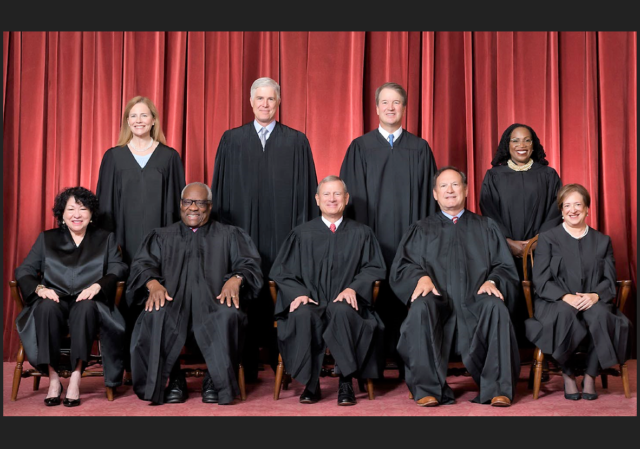
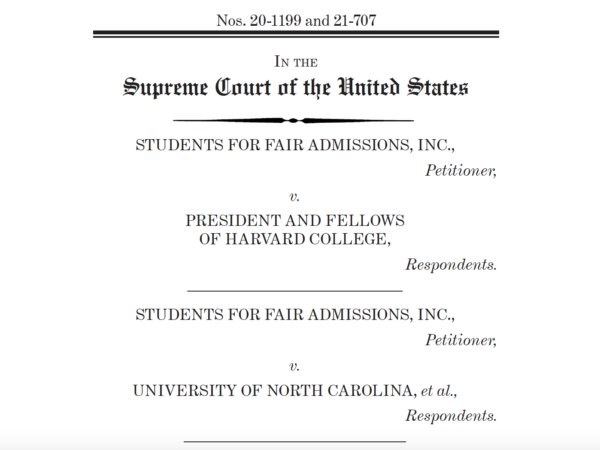
    During today’s oral argument in the cases of Students for Fair Admissions v. University of North Carolina and Students for Fair Admissions v. Harvard, Justice Kavanaugh, joined by Justices Barrett and (to a lesser extent) Gorsuch, hammered counsel about whether that 25-year mark is a hard deadline. Justices also asked how to measure the success of diversity efforts and how the Court should respond if “diversity” could not be achieved by race-neutral means at the end of 25 years. Justice Alito also seemed dissatisfied with responses to his questions about, how much diversity is enough, implying the hunt for a “diverse” student body was just a quota by another name.

    Justice Kagan tried to flip the script on this, asking petitioner’s counsel, “Is there a limit below which you can use racial criteria?”

    Justice Barrett asked Harvard’s counsel, Seth Waxman, whether the university’s admissions policies had changed appreciably in the last fifty years. No, Waxman replied. In that case, Barrett followed up, how should we think there’s an end point? “We’re getting closer,” Waxman insisted.

    Near the end of oral argument, Kavanaugh asked U.S. Solicitor General Elizabeth Prelogar whether Grutter meant that racial balancing would be illegal 25 years after it was decided. “I don’t think that’s how the Court understood it,” Prelogar responded. “The Court expected the rate of change would let racial considerations end.”

    Meanwhile, counsel for petitioner in the case against Harvard argued that the university never seriously looked for race-neutral alternatives until years after it was sued by Students for Fair Admissions.

    Justices Thomas and Alito and Chief Justice Roberts seemed generally skeptical of allowing racial classifications. Thomas repeatedly asked for a clear explanation and evidence that “diversity” offers educational benefits; he was unconvinced by the responses from counsel for the universities.

    The Chief Justice asked, doesn’t racial classification make the point that race matters? He does not seem to believe that squares with the concept of equal protection. Cameron Norris, petitioner’s counsel in the Harvard case, played into that concern in his rebuttal comment. Racial classifications cause resentment and are very harmful, he opined.

    Justice Alito implied racial classifications were so broad as to be meaningless. He also suggested they were too easily caught up in subjective self-identifications. Although he didn’t go into detail about this, he implied it’s not kosher for the government to go back to racial classifications of the kind used in the Jim Crow era (as in, how much Negro blood is needed to classify someone as a Negro?).

    Meanwhile, Justices Jackson (who participated in the case against UNC, although not the case against Harvard, on whose Board of Overseers she sits) and Sotomayor essentially tried to act as counsel for respondents, arguing the cases for the universities. For example, Jackson argued that “Race is never a stand-alone, but one of 40-some factors. [The school is] looking at the full person.” Sotomayor appeared to be constructing an argument that consideration of race is needed to remediate for UNC’s past racial discrimination.

    Near the end of the second argument, Justice Kagan asked Prelogar, “Does Brown [v. Board of Education, which banned separate but equal segregation against black people] compel overruling Grutter?” That gave Prelogar the opportunity to argue, “No. There’s a world of difference between excluding blacks and university policies at issue here designed to bring all races together.” A ruling to the contrary would be “profoundly ahistorical,” in Prelogar’s view, in that it would trivialize the harm of state-sponsored segregation.

    Kagan seemed to sense the wind from the majority, that it may overrule the Grutter opinion allowing (some) consideration of race in admissions, as a modest exception to Brown and to the Constitution’s Equal Protection Clause.

    Here’s another possibility. Instead of overruling Grutter, the Court may reaffirm it, and clarify that 25 years is a hard and fast deadline. It could say, starting with admissions decisions for the class of 2032 (which will be admitted in the fall of 2028 – 25 years after Grutter), consideration and use of race will be absolutely verboten.

    [To read about the brief Legal Insurrection Foundation filed in the case, click here.]

    ________________________

    This post was first published on Legal Insurrection and was written by Johanna Markind.

  • NJ School Board Attorney: “The right of parents is not to dictate what their children are taught”

    NJ School Board Attorney: “The right of parents is not to dictate what their children are taught”

    At a Lawrence Township Board of Education meeting in New Jersey, the school board’s attorney, John Comegno, informed parents that t was not their right to dictate what their children are taught. His comments were made following parent concerns about the district’s transgender policy.

    (more…)

  • Our Top 50 Medical School Database

    Our Top 50 Medical School Database

    criticalrace.org.betasites.soundst.com/wp/ currently has 50 schools in its medical school database. Of these colleges and universities, 39 institutions have some form of mandatory student training or coursework. According to our database, 38 schools have offered Kendi and DiAngelo materials (books, articles, talks, etc.) to their students. The trainings can be targeted, such as a new requirement for a major/department, or school-wide. The trainings can also vary in form (ex. orientation modules for new students, new degree/graduation requirement, online training module).

    Of the 50 schools currently in our medical school database, 28 institutions have some form of mandatory faculty/staff training. The trainings can be department (or committee) – specific or implemented school-wide. And the trainings can serve several purposes, such as onboarding for new employees/faculty or as part of the application process for faculty search committees.

    The subjects of mandatory trainings and coursework are worded differently by college, using terms such as (but not limited to):

    Anti-racism
    Cultural competency
    DEI (diversity, equity, and inclusion)
    Equity
    Implicit bias/Anti-bias
    Critical race theory

    We determined the top 50 medical schools based on US News Best Medical Schools: Research.

    To view our medical school database, click here.

  • Our Elite K-12 Private School Database

    Our Elite K-12 Private School Database

    College preparatory schools serve as a pipeline to the most competitive degrees available in America. Some have embraced CRT as a mandatory addition to the curriculum, while others have varying degrees of programming. For many schools, it’s a continuum of programming, such as “Diversity, Equity, and Inclusion” and “implicit bias” training and programming, that does not easily fit into a Yes/No construct. We provide information from which you can assess the developments. This is not a list of schools to avoid; rather, it presents a database to make the most informed decision possible. We started with the Top 25 lists of the most elite college preparatory institutes from 2021 and 2022. That list now includes the Top 50. We will continue to research and expand this list.

    To view the list, click here.

  • CriticalRace.org Cited in Congressional Resolution

    CriticalRace.org Cited in Congressional Resolution

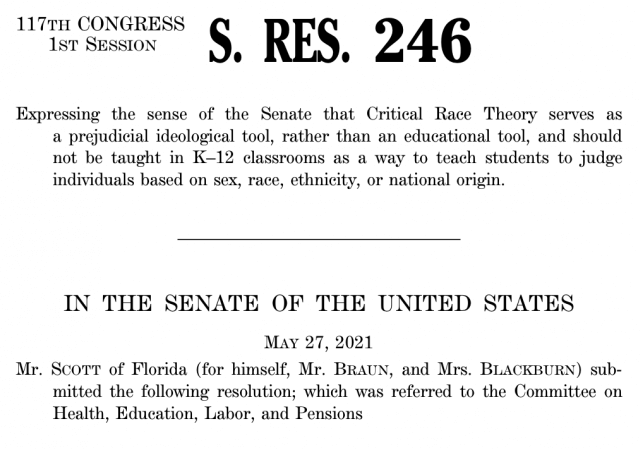
    In May, Sen. Rick Scott (R-FL) introduced a resolution “expressing the sense of the Senate that Critical Race Theory serves as a prejudicial ideological tool, rather than an educational tool, and should not be taught in K-12 classrooms as a way to teach students to judge individuals based on sex, race, ethnicity, or national origin.”

    (more…)